МЛН

Articles by "record labels"
'90s shows @shampooty 100 gecs 101 Things To Do With Your Modem 1080p 1969 1990s 20 is the new 40 2000s fashion 2012 2013 2013: Appropriating a 2013 2014 24 3D Animation 3D Cool World 5.4 A Guide to Buying Haunted Items A. G. Cook A.I. aaron carnes Abelton Abner Jay abstract art absurdism acoustic action action figures Ad Hoc Adam Harper adolescence Adult Swim Adventure Time advertisements advertising aesthetic aesthetics Afterschool Specials AI art Alain Delorme Alan Vega album art alcohol Alejandro Jodorowsky Alexandra Rowland algorithms Alissa Timoshinka Alt Space altered states alvin & the chipmunks ambient American Apparel analyses analysis Andre Ulrych Angelina Jolie Angus MacLise Animal Collective animation Ann Steel Anthony Bourdain Anthony Fantano Anti-art anti-consumerism anti-fashion anti-technology anti-virus software anxiety Apophenia Appropration Aquarium Drunkard aquariums architecture Architecture in Helsinki Architecture of Utopia archive ariel rechtshaid Army of Trolls art Art Bears art installation art museum articles artificial intelligence artist artists ASMR Astral Weeks Austin Psych Fest 2013 auteur authenticity Autonomous Sensory Meridian Response avant garde Avey Tare and Panda Bear b-movies Babette's Feast Baby Blue Baby Cartoon Rhymes bad operation Band People Barf-O-Rama Baroqueikebana Barry Levinson Barstool Sports baseball cards BASEKetball bass guitar bath salts Battle vs Death Battle bbrainz beautimus Begotten believers Ben Butcher Bernard Dumaine Berndnaut Smilde Bertolt Brecht Betamax Plus Bill Doss Bill Murray Bill Watterson Billy Childish bio-dynamic biodegradable urn biography biosonic MIDI technology Black Dice Black Flag Blackest Rainbow Records Blackout Blade Runner Blockbuster blog Blow Job: An Extreme Wind Photoseries Blue Velvet Bob Marley Bob Ross Bongwater Boo Boo books bootleg toys Bradford Cox brain tingles brains Brand New Wayo Brian Brian Eno Britt Brown Brittany Murphy Broadened Horizons: The Ultimate Shit List Bruce Goff Bruce Nauman Brushy Brushy Brutalist Architecture Bubblegum Bass Bubbly Bulbasaur Building the Bridge Burger bus stops butterfly Cadillacs and Dinosaurs Calvin and Hobbes Can cannabis cap_able career motivated Carl Sagan Cartoon Network Casino Night catbite Censorship chandelier Charles Grodin Charles Thomson Charlie Brown Cheddar Goblin children children's books Chillwave chopped & screwed chris cutler Chris Jordan Chris Maggio Chris Marker Christopher Columbus Christopher Reimer Christopher S. Hyatt Christopher White Chrysta Bell Church of the SubGenius cinema click and point games clothes Clothes of the year 2050 Clouds Coci Cocteau Twins Cody Meirick collaboration collage collage art Collateral Damage collections collectors items comedy albums comedy films comedy music comfort tv comic books comic strip comics communication Comus condition consciousness consumerism content drift conversations cooking cookwear copyright cosmic jazz costumes cottagecore cover band Cradle of Filth Crass creepy criticism Crock Pots crown shyness cult films cult movies cultural movements culture Culture Jamming Cyber Secrets #3 Dada Daevid Allen Dallas Observer Damien Hirst Damo Suzuki Dan Lam Daniel London Daniel Lopatin Danni Filth Danzig dark database Dave Allen David Bowie David Henry David Lowery David Lynch David Toro David Zucker Dean Ween Dean Zeus Colman December Decimus 4 decline Definition of Hunk Dennis Flemion dental calendar Derek Guy design Destroy All Monsters Detachment and the Spiritual Life Diane Cluck dick jokes dieworkwear digital art Digital DIY Labels digital trends Dimensions of Dialogue Dimitri Tsykalov Diplo director directory DIS Magazine disco Discogs Discordianism discussions distaste DIY DJ Dog Dick DJ Evangelion Fan Theory DJ Warlord documentaries dolphins Donka Doka Dope Diglett Dopesmoker Doug Ferguson Douglas Hill Dr. John drawing Drinkfy drone drone music drugs Duane Pitre dub Dudeism Duppy Gun Dustin Wong Dux Content DVD dysmorphia dystopia Earth Eartheater eBay echo chamber edible fixtures eichlers electronic music electronica Eleh elevators Éliane Radigue Elias Mehringe Elizabeth Hart ELO Emily Segal Emily White emo fashion Energy Entourage Ephermeral Work Eric Copeland Eric Lumbleau esoterica essays etienne conod Eurock Evan Prosofsky events Excepter exercises exhibition experimental experimental cuisine experimental music eyesight fake movies fake toys fake tv shows Family Fan Fiction Fandom Music fashion fast food FDA feature films Felicita Felicity fellatio fiction film film reviews films fire place glass Fire-Toolz Fishing Floating Flying Spaghetti Monster Foetus FoFoFadi food food porn Ford Four American Composers: Robert Ashley France Frankie Valli and the Four Seasons Franz Nicolay Frasurbane fraud Fred Camper Freddy Got Fingered free Free Blockbuster free jazz Frutiger Aero Fun Boy Three furniture future pop gadgets gallery Gang of Four Gen Z Generation Y Generation Yawn Genesis P-Orridge genre George Harrison George Plimpton Germany GFOTY Ghost Capital Ghost Modernism Ghostcapital III ghosts Ginny Arnell Giorgio Moroder Glenn Branca Global Village Coffeehouse golden retrievers Gong Goosebumps (TV series) Gorilla vs Bear Goth graphic design grooming Groundhog Day Gruff Rhys Guest Mix Guest Mixes guide guides Guillermo del Toro guitar tunings gummy bears Guo Yi-Hun Guru Guru Gustav Holst GVC hacker culture Hackers hacking Haircut Halloween halloween mix hallucinatory hallucinogens therapy handcrafted objects Hannah Diamond Happiness Harmony Korine harry sword Harvey Milk Hausu Mountain healing HEALTH health & fitness Health Goth hearing loss Hella Hellraiser Hem Sandwich Henry and Glenn Forever Henry Cow Henry Darger Henry Rollins Hippos in Tanks hipster culture hipsters Holger Czukay Holly Herndon holograms Holotropic Breathwork holy fuck Holy Warbles Home Alone homes Homestuck hope hopepunk horror horror movies household objects How to Have a Zen Attitude How to Keep Healthy httpster humaity humanities humor Hung I-chen Hunk Hunk uniform (loosely) hyper connectivity hyperreal Hyperreality I Have No Idea What I'm Doing Iasos ice cream identity Idrissa Diop and Cheikh Tidane Tall Igor Wakhevitch Illuminated Paths Ima Read imagination Important Records independent movies indie fashion indie rock indie sleaze industry news Infectious Disease Balls ink inspiration inspirato Instagram installations interior design internet Internet Archive internet art interviews intoxicants IRL Glasses irony it is most definitely art Ivan Cash Iván Diaz Math J Henry Fair J.J. Abrams Jabberwocky Jack Black Jack Long James Blackshaw James Bridle James Ferraro James Wines Jan Svankmajer Japanese Bug Fights Japanoise Jared Davis Jeff Bridges jeff rosenstock jer Jessica Chen Jessica Ekomane Jif Peanut Butter Jimmy Buffett John Brien John Carpenter John Fell Ryan John Hamblin John Lurie John Lytle Wilson John Maus John McAfee John Olson Johnny Lee Miller Journal of Nervous and Mental Disease Julian Cope Julian Koster Julien Pacaud junk food Junk Food Dinner Kane West Kazumasa Nagai Keippah Kelly Reichardt Keri Russell Kevin Ayers Kevin Champeny Khelifi Ahmed Kickstarter Kids Incorporated Kids Toys Adult Issues kill lincoln Kim Laughton King Frog KinoVino Kiyohiko Senba and The Haniwa All-Stars Kleenex Knitting clock Krautrock Krautrocksampler Kria Brekkan Kurt Loder L.A. La Croix LA Vampires Land art Lauren Boyle law of attraction layout Les Claypool Lester Bangs Life Begins at the End of Your Comfort Zone Life During Wartime lifestyle lilangelboi Lindsay Cooper liner notes linguistics link rot Lipgloss Twins lists literature Little Dolls live reviews live streaming LL Cool J lockdown Lol Coxhill London Longest Recorded Echo Lou Reed Lou Reed: Caught Between the Twisted Stars Love (sculpture) LSA LSD Luca Yupanqui Lucie Thomas Lucky Me Luke Wilson Lumen Lydia Lunch M. Geddes Gengras M. Sage Macauly Culkin Macintosh Plus magazines Magic and Superstition magic mushrooms maintenance art Majestic Casual Malcolm McLaren Malcolm Rebennack Male Chef Mandy Manicure Records manifesto Manifesto For Maintenance Art mannequins manz Marco Roso marijuana marine life Mark Prindle Mark Schultz Martin Short Mary Steenburgen masterpieces Matt Farley Matt Furie Matthew Lutz-Kinoy Matthew McConaughey Max Headroom Max Payne 3 Maya Land Mayan Apocalypse McDonald's MDMA Mean Clown Welcome Meat Clothing media media culture Meditation memes Men Without Hats Meow Wolf merchandise Metal Machine Music Mica Hendrix Michael Gambon Michael Nesmith MIDI Midjourney Mike Hughes Mike Kelly mike park mike sosinski Mike Stoklasa Mindfuck mindfulness Minecraft Miracle Legion miscellaneous Mist Mister Mellow Mix Mixes mixtapes modern music analysis modernism Molecular Gastronomy molly Monkees monkeys monoskop Moon Glyph Moth Cock movements Movie Promotional Merch Unlimited movies movments Mr. Impossible Mr. T Mr. Tinglemittens Mrs Doubtfire Mukqs Mulholland Drive murder music music charts music community music critic music criticism music downloads music journalisim music journalism music marketplace music software music videos music websites Music with Roots in the Aether: Robert Ashley musicians mustard plug Mutant Sounds My Bloody Valentine My Little Pony My Mother's Brisket & Other Love Songs my sharona Myles Byrne-Dunhill NASA natural Natural Materials & Structures: Trend Analysis nature Nautipuss negative influencer neon lights Nest HQ Nestflix new age music New Mexico New York Times news Nickelodeon Nicklas Hultman Nicolas Cage Nicolás Romero Escalada Nicole McLaughlin Nightcore Nightcorey Nimbus Njena Reddd Foxxx No Use for a Name No Wave No-Neck Blues Band noise NOP Nora Ephron Nordstrom Cafe Normcore nostalgia Not Not Fun Not The New York Times NOWNESS NPR Nu Twee nudity Nurse With Wound Nurse With Wound List NY NYC HELL 3:00 OBEY obituaries Obvious Plant ocean oddball music Oingo Boingo Old Joy Oliver Rowe Olivia Newton John Oneohtrix Point Never Online Underground Op Art optical illusion optimism Organ Armani Ornette Coleman outsider art P.T. Anderson Pacific Rim packaging paint paint flowers painting Painting With John paintings pandemic pandora's box Panos Cosmatos paranormal activity paranormal objects parody Party Pills pastoral Pat Murano Pat Pollari Pataphysics Paul Reubens Pauline Oliveros PC Music peace pedalstare Pee-Wee Herman Penny Rimbaud Pepper Mill Rondo perception shifts Perfect Lives performance art Perma personal growth Pete Swanson Peter Shumann Ph.D. Phil Connors philosophy phonebook Phonocut photography pig-snails Pilgrim Simon Pitchfork pizza planetary chocolates plates Plonk art Plop art Plug.DJ plunderphonics podcasts Pokecrew Pokemon Polaris Polluted Water Popsicles Pollution PON STOP NOP Poolside Radio poop pop art pop culture popcorn_10 popsicles poptimism porn post-internet posters pranks predictions Primer Procrastination Principle products prog rock Prolaps promo psilocybin psychedelia psychiatry Psychic Ills Psychic TV psychology public art Public Art Fund punk punk cd commercial punk rock puppetry Quasimoto Questlove quotes R Plus 7 R.I.O. Rachel Anna Simon Radio Broadcasts radio stations Randy Gilson Randy Warhol Randyland rastafarianism raw meat Ray Lynch Raymond Pettibon Readful Things Real Love recipes recommended records record label record labels records recycling Red Bull Music Academy Red City Noise reel big fish reggae reincarnated Religion Rem Lezar Remodernism Remote Viewer Repo Man retro reviews Richard Beck Richard Sears Rick Moranis Rick Springfield Ricky Allman Rinse.fm RIO Rob Tyner Robedoor Robert Anton Wilson Robert Ashley Robert Chistgau Robert Greenberg Robert Indiana Robert Smithson Robin Arnott Robin Williams robots rock in opposition Roddy Piper Roger Ebert Roky Erickson Ryan Hemsworth Sally Fields Salvador Dali sampling Santa Fe Sarah Davachi sausage scams scans scary Scary Stories To Tell In The Dark sci-fi science science fiction Scotland Scott Shaw sculpture Seatec Astronomy self improvement self portrait serious? Sesame Street Seth Cohen Seven Figures severance Severed Heads sex sex tapes sexy Shane Caruth Sharkula Sherman Hemsley sherpas shoegaze short films sign offline signs Simpsonwave Site-Specific Art ska ska against racism skateboarding skeptcis skull slackers slang Sleep Slime Cake sludgefest Slyme Records Snoop Dogg Snoop Lion So You'd Like to...Be an Anti-Gen Xer (Part 1) So You'd Like to...Be an Anti-Gen Xer (Part 2) social networks Soloman Chase Sonic Wonderland Sonic Youth Sopa Pipa Sophie sound sound archives sound art soundcloud SoundSelf space space plates Space Trips Spencer Longo SPF420 Spider-Man spirituality spoof sports St. Bernard's Sports Star Trek Star Wars Stephen Colbert Stephen Gammell Stereo Mood Steven Stapleton still life stoner comedies stoner metal stoner movies streaming Stump Subcultures subversive humor Subvertising Suicide summer Sun Araw Sun Ra Sunday is Raining sunglasses sunshine pop surrealism sustainable fashion Swans synesthesia System Focus T.V. Shows Taco Bell Taiwan TALSounds tasteslop tattoos technology teen drama Television Ten Steps on How to Become a Slacker Terrence Malick thc The 13th Floor Elevators The Adventures of Pete & Pete the angles of comfort The Apples in Stereo The Art Box The B-52s The Baseball Card Vandals The Beach Bum the bear The Big Lebowski The Birthday Party The Black Madonna The Bread and Puppet Theater The Coen Brothers The Congos The Day My Kid Went Punk The Family International The Frogs The Great Puke-off the handmaid's tale The Illuminatus! Trilogy The Incredible String Band The Jetsons The Last Trick The Life Stains The Lounge Lizards The Master The Master Musicians of Joujouka The Music Tapes the new luddites The Now Age The OC The Odd Recommendation The Oh of Pleasure The Olivia Tremor Control The Phoenician Scheme the pitt The Red Shoes The Relative Band The Roots The Shape of Jazz to Come The Shining The Simpsons The Strokes the studio The Sweet Homewreckers The Sylvers The Tubes The Velvet Underground The Wire therapy Theses on Punk They Live Thibault Zimmerman Things Organized Neatly things that would never have happened until they happen This is how NASA wakes up astronauts Thomas Newman Throbbing Gristle Thurston Moore Tinashe tiny hands tips To the Wonder Todd Solondz Tom Green tomato soup Tony Futura Tony Sly Toro y Moi Tox Modell toys Trans Air Records trash Treasure Hunt trees Trevor Cox Trevor Reveur Trey Parker and Matt Stone tribute Trippy Turtle tromp l'oeil Tron tumblr Tupac turntable.fm Tuxedomoon TV TV Operas TV shows Twee Twin Peaks Twitter udi koorman UK underground art underground music unicorn unknown unpublished Unresponsive Design upcycling Upstream Color Urban Dictionary urban legends Urban Outfitters URL shows V/A - West Indies Funk 3 Val Kilmer Van Morrison vaporwave vapourwave vegan Velvet Underground VHS video Video Art video edit video games video rental videos Vince Guaraldi Vine vintage vinyl Vinyl Marketwatch Virtual Reality Wabi-Sabi Want to save your eyes? Change your light bulbs. Warp Records Washed Out Waterpark weapons websites WEDIDIT Weird Al wellness Wendy's Wes Anderson WFMU What Makes A Bad Movie Enjoyable? WHTEBKGRND wifislilangel Wikipedia Wild Man Fishcher Will Oldham Williams Street Winston Riley Wolf Eyes Women Woods Y2K Yellow Swans youth culture youtube YouTube Poop Zebra Katz zen Zen Filmmaking Zim & Zou Zin-Say Zonal Zoom Lens
Showing posts with label record labels. Show all posts

Britt Brown (Not Not Fun, Robedoor, LA Vampires): Interview

Britt Brown (Not Not Fun, Robedoor, LA Vampires): Interview
“Ours is a thin-skinned generation, and a lot of artists harbor surprising venom toward anyone who isn’t buying what they’re selling.”


In February, the dynasty of Not Not Fun celebrated a decade of releasing music. Drawing from rock, “experimental,” psychedelic, dub, noise, and house influences, the label has been home to a plethora of musicians and artists, paving the way for plenty of them in the music scene too through the Bored Fortress 7-inch club and offshoot label 100% Silk. Britt Brown, co-owner of Not Not Fun, has grown from Weirdo/Begeirdo and Robedoor to Topaz Rags, Barrabarracuda, Quintana Roo, and a little Pocahaunted to Vibes and LA Vampires; a little of everything, really — all alongside label co-owner, frequent band mate, and significant other Amanda Brown (also owner of 100% Silk and vocalist of LA Vampires). 
Tiny Mix Tapes recently caught Britt moving boxes to a new Not Not Fun headquarters location.

Yo, Britt. How you doing? Just haulin’ boxes?
Yeah, trekking back and forth between this rusty storage shed and our new place. The new apartment is kind of compact; we can’t stock that much. We try and distribute most of it but it’s unpredictable as far as which stores want what and how many. Lately, there are so many record shops in L.A. Most of them have pretty specific agendas in terms of what vibe they rep, but some are loose enough that you can just stop in, explain you’re local, and they’ll take a couple of copies of something, even if they’ve never heard of it because they only read Pitchfork or Spin. Brick-and-mortar records store can’t just operate on internet conglomerate logic though, they have to feign some semblance of actual community or they tend not to last. 
Do you feel like this is an admirable aspect of L.A. specifically, compared to or similar to when Not Not Fun first began?
To me the admirable aspect of L.A. has more to do with how it’s laid out, how much sprawl there is. That’s part of why people migrate here, so they can escape into their own little zone. There’s no pressure to be public or social or even that productive. Artists from Europe or the East Coast are always coming out here for little three-month sojourns, renting an Airbnb situation in the hills where they can fuck around on some project, smoke weed, take a break from real life. 
In L.A. you don’t really run into people unless you choose to — you’re kind of cut off. To some that could seem sort of lonely but I see it more as this evolved mode of privacy, all these parallel lives. You never really know who lives here. Frequently a friend will tell me how some mutual acquaintance has been crashing in L.A. for the last year and I never saw them once. Unless you eat at the same taco truck or share some habitual activity, you’re off on your own path. 
Throughout the 10 years of co-curating Not Not Fun, which year has stood out to you the MOST?
I won’t be good at this question because to run a label for real I think you need to be fairly deluded. You have to always be drinking your own Kool-Aid. You need to constantly feel like the shit you’re putting out NOW is as awesome as anything you’ve ever done. The current crop should always be your favorite. 
Naturally you feel fondly toward certain eras and phases when you met deep new friends, or felt connected to a community in some kind of tangible way. But being nostalgic for your own past is the beginning of the end. Day-to-day we’re both pretty good at looking forward.
Good call. Then, throughout the years, what has been some of the most memorable ways Not Not Fun musicians have reached out to you prior to releasing their work?
Most of the stories that come to mind aren’t of people we ended up releasing. We came home one time and there was this 15-year old kid from Mexico who had hitchhiked to our parking lot with like a duffle bag and an acoustic guitar. Apparently he’d heard some early NNF release at one point and was like, “You guys are the only people I know in the city.” We were impressed what a freewheeling beatnik the dude was but he was definitely a stranger, it wasn’t like we’d ever corresponded before. He didn’t even have a tape to hand off or anything, he just asked if he could play us some songs right there. They were alright, strummy, kind of campfire jam-style, but we gave him some CDs and something to drink and suggested spots he could hitchhike to next. Never heard from him again. 
But most times it’s more mundane, like through a friend-of-a-friend, or someone happens to be in town and asks to meet up. What’s more common is getting stuff in the mail, a fan-turned-friend with cool taste who finally starts recording shit and sends it to us. And we definitely amassed a lot of unsolicited demos on the various Pocahaunted tours over the years. I remember one time during our final song, as each member leaves when their part ends, I dropped my guitar and hopped off the stage and instantly a guy was like, “Yo, can I give you this demo?” The band was fully still playing, three girls howling through pedals.
Everyone’s so terrified of being labeled a “hater” — god for-fucking-bid — that the only place people voice something upstream or bold is anonymously, online in some sad comments section.
How has the crowd at shows for Pocahaunted changed with LA Vampires shows?
They’re 100 percent different. When Pocahaunted was active, especially the early era, it was in the wake of that short-lived bubble of earthy, physical music, sort of post-folk/neo-hippie noise or something. So the atmosphere at shows was mainly positive, engaged, open. People would come up to the merch table and really want to connect, or trade their art. Amanda and Bethany definitely got handed some very witchy homemade jewelry by druggy art kids on many occasions. The barrier between performer and audience was porous. 
By the time LA Vampires started playing live the general show atmosphere felt traditional: performers on stage, audience on the floor, play your songs, people clap, everyone goes home. Even the pretty packed shows, where everyone dances and lets loose, you don’t get many people wanting a personal interaction afterward. Which is fine. But when you travel and play a fairly similar set most nights the excitement and diversity of the crowd, and the bravery of whoever bothers approaching you and engaging, that’s the stuff that stands out in your memory. You remember faces, you remember people. You don’t remember $250, five drink tickets, mediocre sound systems. 
LA Vampires live in L.A.
Have y’all ever considered living outside of L.A.?
Briefly. In 2007 there was a phase where Amanda thought she might want to move to the East Coast, since she went to school there and that’s where her mom and certain friends were living. Occasionally she’ll joke about wanting to move to Europe too, but other than that, no. We’re both too obsessed with California. 
You and Manda got married fairly early in your lives (assuming y’all will LIVE FOREVER). How has that benefited and taken away from your musical work, both solo and together?
It works for us. I mean, Amanda doesn’t have much to do with Robedoor beyond saying she likes a particular riff or thinks our amps sound disgusting, and I know we share some ex-bandmates who might have preferred not to be in a group where two members were in a relationship, but they’ve all happily gone solo now. I’m sure it’s probably less satisfying to be in a band with your spouse if you don’t think they have awesome ideas and a unique aesthetic, but I’ve never had that problem. Doing music together for so long definitely bonded us in a different way than just dating would have. 
There’s so many musicians out there that make, you know, pretty great music, solid cassettes, but if they joined forces with someone else who also had at least above average ideas? Much less if you added a THIRD person with vision to the mix? It’d be a fucking supergroup. Who knows what kind of next level synergy they could generate, united like that.
Considering your writing for The Wire, your year-end bits are typically written in a style most writers don’t employ. Is your style driven by your disdain for year-end writing, or does it peel around the idea that critical viewpoints during this time are very minimal?
Year-end lists are worthless, for sure. But it’s not that I wish everyone was hyper-critical all the time, it’s just that when there’s such a total absence of it then the whole ecosystem of music starts becoming abstract to me — like, why are all these artists working so much, devoting their lives to making and releasing these recordings, and why are all these media subsidiaries waking up every day and strategically hyping this content, and why do all these corporations start spin off divisions just to associate themselves with music or youth culture, if we operate as if nothing anyone does sucks? And I’m not talking about nitpicking Riff Raff or chiding Animal Collective for being slightly less zeitgeisty or something. I’m talking about intelligent disagreement with mass cultural consensus. To me it seems incredibly sane to feel wary toward something that EVERYBODY LIKES. Maybe I watched too many body-snatchers movies as a kid. Either way, everyone’s so terrified of being labeled a “hater” — god for-fucking-bid — that the only place people voice something upstream or bold is anonymously, online in some sad comments section. 
It’s opposite in person of course. At a party or a show, “off the record,” most creative types have a million gripes: who’s overrated, who’s phoning it in, who’s fake, who’s pretentious. This is deeply normal — if you’re invested you care. Plus, people are fucking snowflakes, they’re crazy-particular and generally hard to please. But weighing in with a publicly contentious opinion is risky because the Western world is a ridiculously sensitive place. Ours is a thin-skinned generation, and a lot of artists harbor surprising venom toward anyone who isn’t buying what they’re selling.
You have stated, “Having a face-to-face experience is like a ghost-town in L.A.,” insinuating a lot of American musicians are faceless in musical communities because of the internet. If someone were to suggest they play live do you believe there would be an evolution in their sound or setup?
Totally. Subjecting what you make to a public context changes it. Even on two-week tours a band’s sound will change. Night after night performing for people, feeling what rhythms work, what parts fit. People are staring at you, judging you, because you invented some moniker, drove to their hometown, charged them $5, and then turned your shit up loud. It’s a moment of truth — do you have anything dynamic to impart? 
Society’s not for everyone though, so I appreciate pure loner-ism too. We get plenty of demos from people explaining how they live somewhere with no music scene or record stores, where no one likes what they like, and there’s no one to collab with so they just make music in a vacuum and download torrents all day. I empathize. Growing up in Dallas in the 1990s was mainly a void. Best you could do was see Butthole Surfers at some overpriced sports arena. Digging deeper took dedication. 
You also mentioned how modern music is splintering off into “incommunicable cults of personality” — could you flesh that out for me a bit more?
All I meant by that was the vibe where the musician’s persona is as much a draw as the music. Sometimes that’s in a sort of “spectacle” way — like when an artist or band is known for doing deranged shit at shows, pissing on the audience or whatever, so people roll out regardless of admiring the actual music — and sometimes it’s just that the artist is unusually charismatic or has, I don’t know, like an aura almost. This isn’t at all a bad thing, or a new phenomenon, but it is a situation where what’s generating the interest isn’t purely the music — it’s like a belief in the “character.” For instance if you’ve ever met Jeff Witscher or Charles/Taterbug you’re probably not surprised that there’s a total cult of weirdos and music dudes all across the country who go to all their shows, mimic their slang, get similar tattoos, even dress kind of the same. There’s this idolatry aspect that’s beyond fanship. But this dynamic exists at all levels. People are definitely more interested in Grimes the person than Grimes the music. Same with Sky Ferreira, and tons of other people, rappers, Twitter stars, artists, actors, whoever. It’s not uncommon. 
This closely follows along with the article you wrote at the beginning of last year about how solo musicians had dominated 2012’s quantification of music. How did you see this evolve or devolve throughout last year, and potentially into this year?
I wouldn’t use the word “evolved,” but it continued, for sure. Statistically, there’s less money to be made in music now so people are less and less inclined to split it. First step is to go solo. Then you start your own label, “Artist’s Name Records,” then you tour nine months of the year. People love this fantasy of independence. When that recent Beyoncé album came out there was this ticker-tape quote of hers running under her videos on Fuse or MTV or whatever that said basically, “I hope by doing this I can be an inspiration to all women and artists on how they should never have to share their money with ANYONE.” [mimicking Beyoncé voice]. What a joke. Her entire existence is based on having a paid staff of people to write her songs, lyrics, beats, produce everything, promote the living shit out of it, etc. God forbid Columbia’s staff make a dollar off years of work hustling her brand all over the planet. 
What bums me out most is just the ebbing away from that communal aspect of music. I totally romanticize musicians playing together — not as hired guns but as a real team. There’s so many musicians out there that make, you know, pretty great music, solid cassettes, but if they joined forces with someone else who also had at least above average ideas? Much less if you added a THIRD person with vision to the mix? It’d be a fucking supergroup. Who knows what kind of next level synergy they could generate, united like that.
I remember one time during our final song, as each member leaves when their part ends, I dropped my guitar and hopped off the stage and instantly a guy was like, “Yo, can I give you this demo?” The band was fully still playing, three girls howling through pedals.
And then there’s PR helping these people go beyond just their community and access a general majority of people that could potentially enjoy their music — which again ties back into year-end nonsense. How do you figure PR enhances this intention of quantification of music?
It’s basic boring capitalism. American Apparel would have a tenth of the brand recognition they have if they hadn’t bought back-cover ads in a thousand different magazines for a decade straight. When a major release comes on deck 90 percent of music websites run interchangeable posts about it: “Wow, this Disclosure band is something special!” Only rarely is hype organic. Most of it’s paid for. 
That said, people aren’t sheep, you can’t convince them to like something just by dunking their face in it repeatedly. But you can implant it in their consciousness. And that has a real effect. So many shitty movies break even because the studio blanketed every bench and bus and billboard with posters, and it seeped into people’s brains enough that they found themselves Netflix-ing Olympus Has Fallen or some garbage. A Tame Impala record isn’t any different.
PR plays into the Darwinism of music, which I have a personal aversion to. For the first eight years of NNF we didn’t have anyone handling that side of things, we just sent promo copies to whoever we’d had a personal interaction with. That’s dinosaur-style though; that won’t get you shit in 2014. 
You wrote for The Wire that the critical infrastructure of music “plugs into the same loop [of music coverage].” Have you found any websites that review or promote in a way you enjoy, that keep it real?
There’s specific writers I like. Matt from Yellow Green Red is pretty thoughtful and intuitive. William Hutson, too, he writes for The Wire; his takes on things are nuanced and he calls stuff out for being lazy, which I’m into. Dwight Pavlovic from Decoder is a surprisingly good listener — he describes sounds in a way that’s not cribbed from one-sheets or other reviews, which is depressingly rare. So, yeah, definitely. 
But obviously the majority of music sites are defined by whatever gets them page hits. It’s a business; they need those McDonald’s and Red Bull ads. So, whatever facilitates that: Lana Del Rey remixes, wacky Odd Future tweets, corporate techno festivals, James Blake’s headphone preferences, whatever. None of the big sites have any interest in rocking a boat. 
I’m not calling these publications posers, I’m just saying that if a website has basically identical content to 20 other websites then why fight so hard to act like yours is uniquely important? You wanna stand out? Pan Yeezus. Admit the limitations of Julia Holter’s vibe. Obviously I’m kidding, this would never happen. 
I think Tiny Mix Tapes’ approach has gotten pretty offbeat the past couple years, with these über-intellectual idea orgies. I’m not a dropout, but I didn’t go to school long enough to understand all those post-structuralist/Baudrillard/meta-times-meta concepts the TMT staff is always snorkeling in. I don’t mind confusion though. And “dense” and “indigestible” are hardly buzzed advertiser keywords, so I appreciate that.
That’s right, you actually mentioned to me digging TMT’s feature “The Trouble with Contemporary Music Criticism.” Where do you see Robedoor falling within this idea of “the musicians being the real critics?” Do you feel it falls along the lines of dark music or perception of occult?
I did dig the piece, but it was really heady. I’m not sure I got it all. But speaking clear-headed about Robedoor is pretty impossible for me. It’s a real ritual of friendship at this point, I’m not really sure who it’s for or how it’s intended to be perceived. It’s born from a pretty isolated state of mind. 
Robedoor live
I’ve heard this crazy statistic that only 75% of iTunes has been played, like people just clicking through albums. YOU even wrote, “A person could spend a lifetime clicking and skimming without grazing a fraction of what’s out there.” With that in mind, would you mind indulging readers about what’ll be coming out on Not Not Fun for 2014?
Well I just picked up this Bronze LP for their release show tomorrow. They’re amazing, this totally unclassifiable lifer trio — an actual band, so it’s very novel. Later we’re doing this conceptual Umberto EP with Matt reworking one of his old songs and remixing it under an alias on the B-side. It’s different, really long. We’re also doing this Swanox LP this summer, it’s pretty epic in a homeless sort of way. He’s a really funny guy, his songs have this authentically busted vibe I’ve always been drawn to. What else? A new Cuticle record, a Skeppet LP. Some tapes. Plenty of stuff. We’ll hit the NNF300 mark for sure. Also a new Maria Minerva album in April. 
To end on one of the first questions I’ve asked you way back, but… what’s your epic tour story?
Oh right, shit… Most tour road warriors I know have way more psycho stories but one memory that me and Amanda always reminisce about is this one super-bizarre event LA Vampires played in Cairns, which is this tropical town in Australia that only tourists and bogans go to. It was our first day there, and we were already zombified from the 16 hours in a plane, but as night fell these heavy storm clouds rolled in and it start[ed] raining torrentially. But the “show” was this crazy outdoor arts circus — fire-jugglers, aerialists swinging from poles, barefoot children dancing in mud, video projections on broke-down school buses, like some Merry Pranksters family freakshow. The other musical performances all involved homemade helmets, extended improv, lots of spoken word. The crowd wasn’t phased by ANY of it — they laughed and drank wine in the rain, loving all of it. We played in this cramped wooden room near this kitchen/bar area and people danced till our gear fell off the table and we had no songs left. At 3 AM we took a taxi to our hostel and slept for 15 hours. Then we killed two full days there, wandering weird fruit markets and watching backpackers with dreads play digeridoos on the street. I don’t know if that’s a “story” but it felt fucking surreal.

System Focus: Inside 1080p, Zoom Lens & the New Digital DIY Labels

aaa Ten80p setting 2In his monthly column System Focus, The FADER’s favorite underground music criticAdam Harper stares deep into the internet’s gloom to unearth emerging musical forms.

Are we beginning to see a new phase in DIY music production? Could be. The DIY age began in earnest in the 1970s, when home-taping made recording studios and manufacturing plants unnecessary—although some sonic and logistical disadvantages remained. But now the DIY underground is rapidly going digital. Often using no more special equipment than the laptop they use to check email or do school work, artists can produce and upload their music and be only a URL away from anyone with an internet connection. You might have expected this state of affairs to make labels—whose role it usually is to organise the discovery, representation, manufacturing and distribution of their artists’ music—redundant in the modern era. And as a result, you might have expected music producers and their listeners alike to be reduced to an atomised population of lone computer-clickers. But curiously, labels are flourishing, and they form key nodes in a new form of DIY musical culture that is as sociable as ever. How did these online labels form and who’s behind them? How do they work, and what drives them?
When I started turning to Bandcamp and Soundcloud for new music, I was surprised to find so many labels out there. It soon became clear that a good label is still a good place to find good music, and a specific label a good place to find a specific sound. I now have a list of nearly 100 labels that I try and check in on every once in a while (some of my favourites not otherwise included here are AVNL, Beer on the Rug, Business Casual 87, Carpi Records, Crystal Magic, Feelings, Fluorescent Records, Fortune 500, Hoko Sounds, Orchid Tapes, PIR▲.MD, Purr Tapes, White Colours, and Zoology Records). But with physical releases and often even requests for cash taken out of the equation, the role of these labels had been boiled down to little more than their curatorial and centralising function. It’s all the more surprising, then, to find that that the tastes these labels exhibit are typically so stylistically broad. Plus, these labels are frequently interconnected as part of a vast online network, sharing artists, cooperating on releases, exploring similar sounds, and following each other. With such labels often presenting a relatively opaque web facade, I was curious to know about the world behind them, its people and processes. Normally it’s the artists themselves who get interviewed, but this emerging scene is just as much about the efforts and passions of those who form its connective tissue by running labels. I interviewed six of them, and invited them to send in pictures of their worlds. They very warmly obliged.
One of the things that kick-started my curiosity about this new class of labels was when I received a box from Florida. It had been packed by Josh Rogers, the current manager of theIlluminated Paths label. As well as several cassettes (including a reissue of LATE NIGHT DELIGHT by Luxury Elite and Saint Pepsi, one of the key vaporwave albums), it contained a map of Historic Downtown Melbourne, FL, a State Farm Insurance keychain, a Lucky Charms straw, a section of a t-shirt from the Bluewater Network, a newspaper called Pet Gazette (featuring the cover line “Your Valentine Pet is Right Before Your Eyes-LOOK Inside!”), a couple of off-brand Pogs (remember them?), a toy cow you can clip together, all kinds of flyers, and, best of all, an expansive bib for a restaurant called Captain Quackenbush: The Seafood Specialist, featuring an ecstatic cartoon lobster (who is, in turn, wearing a Quackenbush bib). Not the sort of thing you find in England, where I’m based. Rogers often mails off cassettes with, as he puts it, “local and abroad ephemera from my travels and otherwise” included. It was a strikingly personal touch, suggesting a store of memories from a lifetime, and was all the more intriguing given the label’s relatively unforthcoming Bandcamp presence.


Behind its gentle blue homepage, however, Illuminated Paths—founded in 2012—is one of the leading vaporwave labels (alongside Fortune 500 and Business Casual 87). Vaporwave has been one of the most prominent and widespread movements in the online underground recently, involving loops and edits of slick post-’80s styles like adult-contemporary funk or corporate muzak. As well as the classic LATE NIGHT DELIGHT (‘We sell out of that one every time we order or create more cassette stock,” says Rogers), there’s Miami Vice’s beachside reverie Palm Haze, 회사AUTO’s stuttering hangtime chillout new​.​age∮86, The Editor’s dizzying culturejam Editorials and Stereo Component’s peppy autorunning diskette Coastal Nostalgia. Other albums, such as DIY▲PYЯΛMID’s V O L U M Ξ T R I X X with its heaving, queasy textures, or syrrup’s Potion Vapors with its gentle yet cavernous R&B, push the genre’s form and content into new areas. But while Rogers is happy that his label has been called “the king of vaporwave,” he’s not sure what the term should encompass, and many of the label’s releases lie beyond even its most widely drawn borders. They include shivering ambient textures of Strange Mountain’s Levitation Mist, the alien transmissions of Blob’s Mirage and the digital twistings of Treasure Hunt’s Hacker. Situated “on the space coast of Florida, a few short minutes from Daytona Beach and Orlando,” Illuminated Paths “honors about 25 to 50 cassette orders a week,” says Rogers, often using “20 plus year old vintage used cassette stock.” Digitally, the label “reaches thousands of people daily,” but the firmly pro-lo-fi Rogers tells me that future releases could appear on formats such as vinyl, 3″ DVD, VHS and even floppy disk.
Miami Vice’s beachside reverie Palm Haze, out on Illuminated Paths

Based in Johnstown, Pennsylvania, the Ailanthus label has also been instrumental in vaporwave, especially early on, releasing INTERNET CLUB’s DREAMS 3D in June 2012, sharing a number of artists and even releases with Illuminated Paths, and recently uploading Metallic Ghosts’s latest meta-vaporwave statement SkyTower 2032. Founded in June 2011, the label is named after a rapidly growing invasive tree that takes root in Pennsylvania where forests have been cut down. “I saw this as a beautiful metaphor for punk rock,” says Ailanthus’s manager Scott Michael. This particular frond grew out of the now-defunct blogRoberto Clemente Rookie Card, which accompanied a college radio show and now leaves a great archive of the rise of the online underground—hypnagogic pop and vaporwave in particular. RCRC became a community nexus that moved onto the archetypical social network around 2011: “Myself and a lot of people that I had been corresponding with through RCRC began finding one another on Facebook and we started really getting to know one another,” says Michael. “We made secret, closed and public Facebook groups wherein we actively developed brand new cultural signifiers for our new community. Each and every one of us was doing something completely different from the next and we were all coming from such vastly different backgrounds, cultures, generations, class, etc. Collaboration was key, we all supported one another and that naturally lead to collaborations, cross country meet-ups, labels, websites, web concerts, we started doing whatever we wanted. The community is different for everybody, but it means a lot to everybody.” In May 2012, the label switched to digital-only, and as word of vaporwave started to spread, the label’s traffic doubled exponentially. But again, Ailanthus’s tastes run further than vaporwave. Michael lists them—”drone, rap, folk, pop, punk, prog, collage”—but then decides that the only genres his label really has are “2011, 2012, 2013 and 2014.”Richard MacFarlane’s ironically-named cassette-and-digital label 1080p also followed on from a blog, in this case Rose Quartz. Originally from New Zealand, MacFarlane moved to Vancouver two years ago and now studies web development. “I feel guilty doing 1080p work while in class which is usually the case,” says MacFarlane. “[It's] kind of a jacked up hobby, really.’ Only a year old, 1080p nonetheless has an impressive and diverse collection under what MacFarlane calls “a loose umbrella aesthetic of peripheral electronic music,” incorporating “the areas in-between some sort of club and anti-club dichotomy”. That includes such highlights as McFerrdog’s Club Amniotics (club sounds in a parallel universe), Karmelloz’s Source Localization (an uneasy mesh of organic and hi-tech materials) and AT/NU’s Psi-Grove (icy ravescapes for Arctic Circle backpackers). 1080p is part-local, releasing Vancouver artists such as LNRDCROY and rapper Young Braised. MacFarlane says the city has “a really amazing scene of after-hours dance parties and live shows” alongside its “perfect size” and the “mountains out my window.”1080p’s Richard MacFarlane

Founded in 2011, Aural Sects is one of the most net-savvy labels I spoke to, putting out free digital-only releases at the heart of the online underground community, and its Bandcamp page proudly proclaims “BORN ON THE INTERNET // ALIVE IN SOCIAL MEDIA.” The managers of the label are Joe Royster (also known as spf50, based in Northeast Tennessee) and Bunny Intonamorous (who I spoke to, also known as Pe† Ceme†ery, based in the UK’s Manchester), with Micah Clark (also known as I AM WATER, based in Washington, DC) working as the label’s “main visual guy.” Like Ailanthus, it sprang from digital social networks: “Originally we were all just fans of the earlier witch house sound that congregated in certain corners of the internet [such as a Facebook group called Witchbook],” Intonamorous explains. “After a while of creating and sharing music with each other, we had the idea to try to create a more formal space to swap our works-in-progress and try to put some sort of structure together to bring more attention to each others’ works. It actually took a while for us to hit on calling it a collective and label.” Now the label is run “entirely via Facebook private messages,” he continues. “For group discussions we’ve got just a couple of secret Facebook groups that we operate out of—one for the artists to interact, and one just for the management team, so we can keep the boring logistics stuff out of people’s way.” Recently, the label has been heading further afield from witch house, and into “what has now become known as the ‘post-witch community’,” releasing slightly spooky dancier albums byMarie Dior and Old Manual, and curiously seductive, semi-pastiches by Nancy Letitiaand Xyloid. “If sounds are predictable,” Intonamorous says, “and the music itself is predictable, it has no value as part of the wider scale of musical culture.”


The Zoom Lens label goes even further with the net-based ideology than Aural Sects, emblazoning its Bandcamp page with the legend “WE ARE A LABEL AND COLLECTIVE OF MUSICIANS. HUMANITY ACROSS THE DIGITAL DIVIDE. DIGITAL PUNK ROCK SPIRIT. FUCK REAL LIFE.” Today, the label has a clear Japanese-influenced aesthetic of sweetness and dreaminess, with joyous 8bit from Yasumiyasumi and Slime Girls, and gentle pop from Yoshino Yoshikawa, Yeule and i-fls, bittersweet like a green tea latte on a rainy Sunday afternoon. But the aesthetic has darker roots, which you can often detect as you listen deeper. The name Zoom Lens is a reference to serial killer Tsutomu Miyazaki, and its imagery is a conscious attempt at confronting and defamiliarising the visual objectification of women (and its consequences). Co-manager Garrett (who records as Meishi Smile) began in the Orange County experimental music scene as a noise musician before founding Zoom Lens. “The first release was packaged in a clear DVD case limited to about 20 copies, which contained a letter soaked in my own blood,” he recalls. Now he runs the label alongside Michal of San Francisco’s The Bilinda Butchers, and is broadening definitions of punk—the Japanese connection “has given Zoom Lens its sense of ‘punk rock’ aesthetics. To enjoy anime in the United States is punk rock. To listen to J-Pop is punk rock.”Zoom Lens stickers

With its Japan-centred aesthetic, Zoom Lens has built a bridge across the Pacific, and as well as signing Japanese artists, Garrett recently performed in Japan. Geography is no barrier to the modern underground label. Illuminated Paths has artists from Poland, Morocco and Indonesia: “Where I’m based really has no bearing on how IP is run,” says Rogers. “I could truly be anywhere. Just so long as I am close to a wi-fi connection and a post office. There is a certain satisfaction that comes with being on a drive through the country, the wind through the open car window, and having my phone alert me that yet another IP release has found a good home.” Ailanthus has “released material from every continent on Earth except Antarctica.” Bandcamp also puts local labels on an international stage. The Dopefish Family label, run by Andrei Mitroshin, almost entirely represents the underground music scene of Omsk, a city in Siberia not far from Kazakhstan that has a population between that of San Jose and Dallas. Yet stylistically, it stands alongside US labels, with its pseudo-corporate vaporwave and post-Dilla beats.
Dopefish Family’s Andrei Mitroshin

If anyone in the world can instantly tune in, then, what do these labels know of their audiences? “We know almost nothing,” says Dopefish Family’s Mitroshin. Ailanthus’s Michael has a bit more of a picture: “I notice a lot of European listeners, lots from Russia, a lot from the US, lots from Brazil and France. People always seem to be as stoked as I am about new releases.” Some of Aural Sects’ audience “are ostensibly witchkids, old and new,” while “some are very much the generation of net-natives who are always looking for the bleeding edge of strange new sounds,” posits Intonamorous. Listeners regularly write messages of support, says 1080p’s MacFarlane: “People often send a note with their Bandcamp purchases which is real nice.” But the space these labels offer their audiences is more than just one of enjoyment. “There are a lot of people out there that are conflicted due to their specific niches hobbies and interests and it’s difficult for them to find a place or network to feel confident in,” say Garrett. “Zoom Lens’ aesthetic and feeling was made to help people looking for a place to fit in. My perception of Zoom Lens’ audience has been people such as myself—losers, in the best sense possible. I’ve known of some people who enjoy Zoom Lens who are in high school right now and are afraid to openly seek out their interests in fear of being called strange, yet they’ve referenced Zoom Lens as a motivation for being more like themselves.” Zoom Lens’ Michal agrees: “Fans see our imagery and aesthetic and immediately feel a sense of comfort because they know that there are people out there that are part of a larger network that feel and see the world the same way they do.”Most of these labels seem to find their artists from a social pool that precedes the founding of the label. But how does the label, and in turn its community, grow? “As I make friends throughout the web, I wanna work with them,” says Ailanthus’s Michael. “I also dig around a lot, mostly on Bandcamp and Facebook these days. I download tons of stuff, all the time, I listen to a strong majority of it and when an artist starts standing out consistently, I wanna learn more about their ideas, concepts, techniques and plans.” Intonamorous of Aural Sects has a similar process: “We have a submission email account that gets flooded fairly often with artists getting in contact with us, but it’s only very rarely we get a gem by that means. More often, I tend to find new artists through either social network contacts or through the tagging, repost and recommending systems of Soundcloud and Bandcamp. I’ve been known to go on a deep dive into the[se] musical backwaters every couple of months for a few days in search of something that sounds new—not even necessarily for the label, just because I’m an avid listener and curious as to what’s going on in the creative underbellies. Typically, if I find something I like, I post it in the Aural Sects management group on Facebook and take others’ opinions on it, but me and Joe get the final say as to whether we make contact.’
Intonamorous sees the role of the label as not just aesthetically curatorial, but giving a leg-up to new artists: “Artists can self-publish, and self-promote, and all the other things that labels used to do, so the only utility in having a label is having something that’s—at least initially—going to get an artist’s music to a much wider audience. We had to reach out to artists and audiences outside of our immediate social sphere in order to grow as a label for the benefit of our artists.” Whether they encounter each other locally or online, 1080p’s MacFarlane “finds the sort of connection you form from putting together a release together is similar to putting on shows for people—kind of brief but very real.”
But for other labels, switches between URL and IRL are rarer. Says Intonamorous, “I’ve known Joe and Micah, who have had most hand in [Aural Sects], for over 3 years and never heard either of their voices.” While this might sound sad or somehow unnatural compared with more traditional musical cultures, there’s no denying that there’s something quite remarkable about how the internet has allowed such different people to come together and work on building something new. That said, sometimes online connections spark in the material world, too: Ailanthus’s Michael says that Shisa, a producer of professional-quality club and post-club sounds and a highly active node in the online underground community, “ended up being from Pittsburgh, which is only like two hours from here. We’ve become IRL friends.” It was over an IRL coffee with another online friend that Michael realized “I had never actually talked about the community or different artists and labels and stuff in real life, like a real informed discussion, never. Some of the names of projects actually sounded strange to say out loud.’ Zoom Lens’ IRL epiphany was revealed when Garrett travelled to Japan: “It was a unique experience because it was my first time travelling to Japan, yet we were able to coordinate a line-up of many of Zoom Lens’ international artists and amass an impressive amount of people both in person and online. It was sort of an affirmation of Zoom Lens’ presence both physically and digitally.”
Many of these labels manifest IRL by releasing on physical formats, of course. For most online labels, that means mail. “Oh man, so much mail,” says 1080p’s MacFarlane. “These days I’ll go once or twice a week down to the post office in Chinatown on my way to school, where I’m on very good terms with the ladies who work there.” But it doesn’t work everywhere: “Russian post is bloody hell,” says Mitroshin of Dopefish Family. “So all physical stuff we make (or will make) goes only with our friends or people that can reach us here.” MacFarlane is fond of cassettes, though: “The physical practicality of them, they are nice and small to post, cheaper and lower risk to manufacture than vinyl and I’ve always had cars with tape decks.” They’re also “like a more casual place to experiment than vinyl that can be released reasonably quickly.” Zoom Lens are keen to point out that their digital approach shouldn’t delegitimize their work. “‘People see computers and producers in one dimension. A lot of people see that as cheating but it’s just the way our music culture is now,” Michal tells me. “Being of mostly digital age I’m sick and tired of nostalgists over-sentimentalizing analogue formats. And to be clear I love vinyl and cassette and using analogue equipment but I don’t feel a strong connection. People like Garrett and I are computer kids and we want to embrace that aspect of our lives into more than just our daily tasks but our music, art, and aesthetics in our own personal lives, as well as our label.”Dopefish Family headquarters

Garrett hopes the label can “move into the direction of digitally tangible releases or limited art pieces. I feel like the existence of physical items is important in preserving our own attached memories to such listening experiences, yet sometimes I feel like it’s impractical in an ecological sense and is slowly growing less acceptable for the shifting musical listening trends.” Then, elegantly and poignantly echoing Zoom Lens’s sonic and visual aesthetic: “We are in constant conflict in losing the physical things that bring us a sense of connection, yet we enjoy the ease of instant gratification.” Ailanthus’s Michael confesses, “I always wonder where these files will be in decades, like what if kids go to thrift stores and rummage old external hard drives for rare internet music.” And Aural Sects releases digitally for free, because “we firmly stick to the idea that artists’ music should be heard by the greatest number of people possible, and a paywall between the music and the audience runs entirely counter to that.”
I was surprised to learn that in nearly every case, the artwork for these label’s releases was chosen or provided by the musicians themselves. ‘With the way technology is these days, they can have a decent album cover ready within a day,” says Illuminated Paths’s Rogers. It reflects the way that in general, it seems that the artists have a greater aesthetic power and autonomy in these labels than they might do even for a conventional indie label. When I ask about the guiding philosophies behind what they release, the answer is always the same: they keep an open minded and simply release what sounds good to them. As Ailanthus’s Michael puts it, “To be able to work with some of my real favorite artists? What a blessing, what a Read more: http://www.thefader.com/2014/06/04/system-focus-inside-1080p-zoom-lens-the-new-digital-diy-labels/#ixzz35X5fkYpK

Sun Araw & M. Geddes Gengras Talk Duppy Gun, Jamming, and The Congos


Sun Araw & M. Geddes Gengras Talk Duppy Gun, Jamming, and The Congos


Sun Araw & M. Geddes Gengras Talk Duppy Gun, Jamming, and The Congos
The first thing I learned from talking to Sun Araw (a.k.a. Cameron Stallones) andM. Geddes Gengras, both Los Angeles-based, free-form weirdos, is that you can actually set up a three-way phone call without video. Who knew?
Stallones and Geddes were responsible for one of the most stunning records of last year, a collaboration with The Congos called Icon Give Thank, released through RVNG Intl. I spoke to them at length two weeks ago about their upstart dub imprint Duppy Gun, born out of their first visit to Jamaica for the Thanksessions. The pair then launched Duppy Gun out of pocket with a massive collaboration between dancehall mainstays Dayone and Early One in tow. What followed over the next year and a half was something of a musical pilgrimage, with Stallones and Geddes taking homemade psychedelic riddims to Jamaica and letting select MCs and vocalists go wild on a track of their choice. They pressed their first record in a batch of 480, but both tunes were solid enough to catch the ear of legendary hip-hop and tastemaking imprint Stones Throw. Stones Throw gave the go-ahead for more of the releases, and over time, Duppy Gun has transformed from a small labor of love and into a spotlight for both underground Jamaican artists and established producers in disguise. Now if there was only a way to get Jamaican music on American radio...
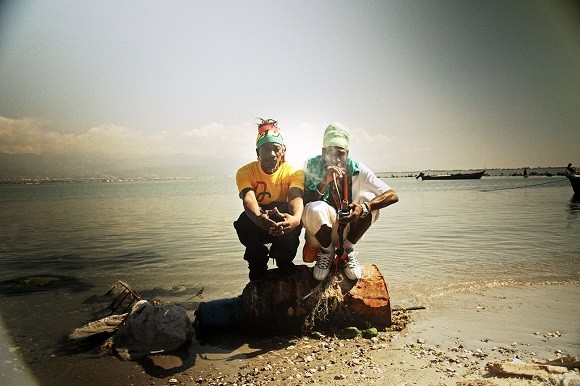
The following interview was a pleasure to conduct, with the pair diving deep into the creative process behind Duppy Gun, the rush of joy and adrenaline of performing with The Congos, and a few tidbits about their upcoming solo projects. All the Duppy Gun releases will be spotlighted throughout, along with exclusive photos from filmmaker/DJ Tony Lowe, who was behind the camera for the documentary on Icon Give Thank.
-- Taken from DPPY001
Ad Hoc: DPPY001 came out in November, 2011, after you went to Jamaica to record with The Congos. Is that where all this started?

Cameron Stallones: Yeah, definitely. The way it works is when there’s a musician in town, or a producer in town, or anything like that, the music community kind of tends to congregate. You show up and try to get on a track or try to play on the record or whatever’s happening. So we kept getting approached by these guys who were saying, “Let me get on the track,” or “Let’s do something.” We were busy working on the Congos album so...for a while we were like, “Uh, working on this other thing.” Then we met these guys, and we ended up taking them into the studio and playing them some little pieces and jams that we had that we weren’t planning on using for the Congos record. Stuff that mostly we thought was too weird or not finished enough, and these guys were immediately jumping on it and just spitting fire all over it. So we were all, “Alright, well, this is really cool. Let’s continue this.” So that’s how we recorded the first single, which was the “Earth,” with Early One and Dayone.
M. Geddes Gengras: I kind of had a long-term obsession with dancehall. You see a different side of performance and of musicianship over there. And also working with young guys who are younger, and more unknown, more trying to get their careers off the ground-- it’s a very different experience.
Ad Hoc: How many tracks did you have prepared when you went down to Jamaica the first time?
MG: All the stuff we brought with us for the Congos record, which was everything that’s on that album and then about three or four loose sketches we had started working on. I think we pretty much used everything we came down with on that trip.
CS: Then we went back for our first trip that was just focused on Duppy Gun, and we brought down about...what was it, twelve riddims or something?
MG: Yeah, twelve or fifteen.
CS: Yeah, something like that. And these were all completed. We farmed them from friendly producers here and far, and also made probably about half of them ourselves.
Ad Hoc: How do you typically work on tracks together in LA?
CS: Rarely... [laughs]
MG: [laughs] Usually we’ll get together either at my place or at Cam’s place and we’ll kind of just sit down and jam on some stuff. Pretty much everything, all the riddims we’ve made for Duppy Gun, have been recorded live, at least the ones the two of us have made. That’s kind of been our style: jamming, messing around, and when it gets somewhere good, we start recording.
CS: I have no digital skills. I’m very much a jammer, so most of our stuff comes out of that, which I think you can kind of hear if you listen to it.
MG: Yeah, the two of us jam on something for ten minutes and then find the best three or four, and try and pull that out.
Ad Hoc: How have you been received in Jamaica?
MG: Oh, they love us in Jamaica. I don’t know how they feel about the music, I guess we’ll see, maybe, but...
CS: Yeah, that’s sort of the work we’re doing right now-- trying to get the records back there in a meaningful way. Stones Throw is helping us. We’re trying to get distribution down there. It’s a real different culture. Honestly, the way things really get moved down there is the radio, getting it played on the radio, so actually we’ve got all the Duppy Gun artists down there actively trying to get this stuff on the radio right now. I really hope they’re successful. It doesn’t seem impossible.
MG: The state of modern dancehall right now is pretty psychedelic as it is. I think we had the experience of, the first time going down there, listening to a lot of radio and hearing the way that DJs mix these records, and how abstract some of the riddims get, and lyrically how crazy some of it gets. I think it occurred to me at that point that we had to do anything, as long as it’s banging.
CS: As far as just the spirit goes, there’s been a long tradition of really weird dancehall, but especially now. People are not really fazed by anything anymore, which is really exciting.
I Jahbar.
Ad Hoc: Tell me about I Jahbar and Fyah Flames [DPPY003].
MG: We met I Jahbar on the first trip. He’s the nephew of Ashanti Roy from The Congos, and he’s one of the first people we met there. On this last trip, he definitely made a huge effort to introduce us to a lot of people that he knew, and took us around to where he lives in Spanish Town, and introduced us to G Sudden, who’s on the next record, and Fyah Flames, who’s on this one. They’re both younger protégées of his.
CS: Yeah. Flames is a neighbor of his, and they’ve been friends for a while. She’s been doing music for a while. She’s a beautiful singer.  In that video that we put out a couple days ago, that’s how we recorded that track: in I Jahbar’s yard in a little farm of his in the hills, above Spanish Town. We met her a day before, told her we were going to come back and record a track. We came back the next day and knocked that out.
We struggled a lot with finding the most productive way of recording. Most of it is literally just playing them the riddim and then they just go for it. The way that a lot of the musicians work down there, especially singers, is they just have a lot of songs on call, and they’re just really ready to fit it to a riddim. They’re really used to fitting their melodies and their lyrics over any sort of riddim. I Jah especially-- he has a huge notebook full of songs, and so whenever we record with him he just pulls out his notebook and finds what he thinks makes the most sense for that riddim.
Ad Hoc: You’re both influenced by dub and dancehall in your solo projects. How do you carry that into the producer's role?
CS: We both have our own creative zone, and I feel like the Duppy stuff that we make together runs pretty parallel to that. It’s usually still the sort of sounds I want to hear at that moment. But we’re making it with a mind towards it being something that someone could do a dance hall track on.
MG:  I think dub techniques are definitely something that Cameron and I both absorbed into our production styles over the years, so there’s always that touch of that. But beyond that, we’re trying to make something that makes sense with the vocalist. I don’t think either of us really spend a lot of time producing music for vocals in that way.
Ad Hoc: Going forward with Duppy Gun, are you going to be doing reissues, or is it just going to be original productions for now?
CS: I think for now we’re definitely focusing on original production. The most crucial part of the project for us was that moment when we played them this stuff that we thought was too weird, and the enthusiasm that it was met with-- that was sort of the “aha” moment I guess. DPPY003 is the first [release] where we have a guest producer-- DJ High Waistline, who produced the Fyah Flames tune. And I Jahbar returns after "Spy" from DPPY002.
If you listen carefully to the beat, you’ll probably figure out who it is, because it’s pretty obvious. But that’s sort of the new frontier-- starting to curate a lot of the beats as opposed to making all of them. So the next [record], DPPY004, actually is two totally different producers; none of our riddims are on that one. We’re just kind of excited to gather a bunch of stuff from a bunch of really talented people and then take it down to the island and get vocals put on it.
MG: I think also there’s a lot of labels out there that do a really good job of digging out super-obscure, old reggae and dancehall stuff and bringing it to the world, and that’s really awesome. I’m definitely super appreciative and super into something like that, but that’s not necessarily what we’re trying to do. I think we’re trying to make it about what’s going on right now.
Ad Hoc: Going back to The Congos-- are you getting ready to go on tour with them?
MG: Hopefully. There was talk of some more shows. It’s always a total liquid process. You never know until the last minute if it’s actually happening, but there’s plans for some shows in September and October in Europe.
Ad Hoc: I saw them at LPR in New York, and they just seemed overwhelmingly enthusiastic about being on stage again.
MG: They’re born performers. They definitely still do it a lot. Not in the States so much, but they play pretty regularly in Europe, and Asia, Australia, South America, where reggae is a lot more popular than it is here. They have really the most amazing attitude and the best stage presence, and just being up there with them is kind of overwhelmingly incredible. I think at the first show we did, that was the thing that struck me the most: just how excited and how emotionally involved everybody was with that music.
CS: We feel a lot of pressure in a sense that it’s a total honor to be playing with them and you’re in a myopic hole and wondering, “Ah, my guitar tone is a little off.” When you take a minute to look up and you see people’s reactions and you see the interplay that’s going on between them and people, you realize, in a really thankful way, that nobody could possibly care about whatever it is that you’re worrying about. And to be able to take part in that and try and express that with them is a really beautiful, really powerful feeling.
Cameron Stallones.
Ad Hoc: What was the response to Icon Give Thank and the Duppy Gun records in Jamaica?
CS: I don’t know. Honestly, it’s still sort of an egg to crack. Most of the artists that we’re working with for Duppy Gun aren’t online in any meaningful way. I know that The Congos love the record, and other friends hear it and love it, so it’s slowly making its way. Still working on radio play, though.
Ad Hoc: One last question: what the two of you are working on right now, Duppy Gun or not?
CS: I’m working on a new record right now. I have been for a little while, kind of really taking my time with it. I don’t really know how long it will be, how long it will take to finish. Also, on the first Congos tour our band kind of became the Sun Araw Band for a brief tour afterwards. It was me and Geddes, Tony-- who made the film-- and Butchy Fuego, who’s a drummer who drummed for us and helped us mix the record. He drums for Boredoms and performs under the name San Gabriel. We all went on a little tour together. We had this residency at a place that has an incredible synthesizer collection called The Worm, in Rotterdam, and made a record. So that should be coming out pretty soon. I just got test presses of it. It’s called the Celebrate Music Synthesizer Group, and it’s a double LP of really bugged-out synthesizer jams!
MG: Right now I think we have two more Duppy Gun records that are done and definitely some material for maybe another one or two. We gotta kind of see where we’re at with that once these two are done. I have a couple records coming out, solo records, in the next year or so. The first one up is a compilation of old cassette releases that I did on this label Umor Rex out of Mexico City, and then a couple other things, another new solo LP, hopefully late in the year or early next year, and an entitled New Lines from my minimal techno side-project,Personable, that will come out at some point.
DPPY003 featuring I Jahbar and Fiyah Flames is out now via Stones Throw. 

MKRdezign

Contact Form

Name

Email *

Message *

Powered by Blogger.
Javascript DisablePlease Enable Javascript To See All Widget